|
FAMILY PAPILIONIDAE
Latreille, [1802]
[The system adopted for the higher
classification within the Papilionidae by Ackery et al.,
1995 closely followed Miller, 1987 (Bulletin of the
American Museum of Natural History 186: 365-512).
).]
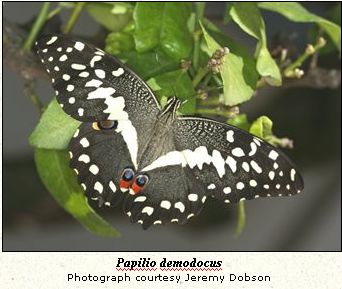 The
swallowtails, swordtails, festoons, birdwings and apollos
are a small family of large to very large butterflies that
are generally showy, conspicuous insects. Included in the
family are the largest butterflies in the world, the
birdwings of the Malay Archipelego, some of which have
wingspans of nearly 300mm. The
swallowtails, swordtails, festoons, birdwings and apollos
are a small family of large to very large butterflies that
are generally showy, conspicuous insects. Included in the
family are the largest butterflies in the world, the
birdwings of the Malay Archipelego, some of which have
wingspans of nearly 300mm.
There are about ?85 Afrotropical species but only 17 of
these occur in southern Africa, one of which is endemic. The
paucity of species in the Subcontinent is due to the fact
that Swallowtails are primarily forest butterflies, with a
lesser number in frost-free savanna. The southern African
species are divided into two groups: the true Swallowtails
(genus Papilio) and the Swordtails (genus Graphium), both of
which are dealt with below.
Female Swallowtails lay their eggs singly on the leaves or
on young leaf shoots of the larval foodplants. For true
Swallowtails these are usually trees belonging to the Citrus
family (Rutaceae) and for Swordtails, shrubs or trees of the
Custard-apple family (Annonaceae).
The eggs are spherical, smooth, pale yellow and are about
one millimetre in diameter. The larva hatches within a week
and consumes the empty egg shell as its first meal. It feeds
on the edges of young leaves and rests in the middle of the
leaf. There are five larval stages (instars), which take
three to four weeks to complete. In true Swallowtails the
first four larval instars resemble bird droppings and in
certain species this resemblance is enhanced by the larva
kinking its body in the middle (?); in the final (fifth)
instar the larvae are green, with some brown or white
markings, are rather slug-like, and are well camouflaged
(?).
In Swordtails the larvae tend to be marked with variously-coloured
transverse bands (?). All Swallowtail larvae have a
remarkable, eversible, forked organ just behind the head,
known as an osmeterium. When the larva is alarmed, this
brightly coloured organ is everted and releases a pungent
citrus-like odour. Swallowtail pupae are long and
cylindrical (resembling a twig), or are leaf-shaped, and are
suspended by a silken girdle (?).
In some species the pupa may be either green or brown,
depending on the surroundings in which the larva pupates.
Such dimorphic pupae are seen in the Citrus and Green-banded
Swallowtails. Pupae may hatch into adult butterflies after a
few weeks, or the pupae may undergo diapause ("hibernate")
in autumn and winter, hatching only the following spring,
some four to six months later. Because of this pupal
diapause, adult Swallowtails are mostly seen on the wing
from about September, reach a peak in numbers in February
and March and become scarce by May. Few are seen during the
winter months (June to August), except in the warmer coastal
areas of KwaZulu-Natal and Mozambique.
Some species of Swordtail that occur in more arid savanna
habitats can diapause as pupae for several years, should
drought conditions persist.
|
|






